At City Post Express, we have shipped tens of thousands of boxes across the Atlantic over the past 25 years. We have seen wine glasses arrive without a scratch after eight weeks at sea, and we have seen laptops delivered in pieces after a five-day air freight journey. The difference almost always comes down to one thing: how the items were packed.
Packing fragile items for shipping is not complicated, but it does require attention to detail. International shipments face more handling, longer transit times, and rougher conditions than domestic packages. Your box may be loaded onto a truck, transferred to a container, stacked with other freight, loaded onto a ship, unloaded at port, cleared through customs, loaded onto another truck, and finally delivered to a doorstep thousands of miles from where it started.
This guide covers the specific techniques we recommend to our clients every day. Whether you are shipping fragile items internationally for a move or sending a care package with breakables, these methods work.
Gather the Right Packing Materials Before You Start
Before you wrap a single item, make sure you have everything you need. Stopping halfway through to hunt for tape or scissors leads to rushed packing and mistakes. Here is what we recommend:
- Double-walled corrugated cardboard boxes — single-wall boxes are not strong enough for international freight
- Bubble wrap (large and small bubble) — large bubble for outer wrapping, small bubble for delicate surfaces
- Packing paper (unprinted newsprint) — for wrapping, stuffing, and filling voids
- Strong packing tape (at least 2 inches wide) — not duct tape, not masking tape
- Markers for labeling
- A second box for double-boxing high-value items
You can buy packing materials from most shipping stores, or City Post Express can supply packing kits as part of our shipping service.
The Golden Rule: Nothing Touches Nothing
This is the single most important principle when packing fragile items for shipping. No fragile item should touch another fragile item, and no fragile item should touch the walls, bottom, or top of the box. Every surface needs a cushioning buffer.
When two unwrapped glasses sit next to each other in a box, the vibration from weeks of ocean transit causes them to rub against each other. Over thousands of miles, that gentle contact chips rims, cracks stems, and grinds surfaces. The same applies to ceramics, picture frames, and electronics. Wrap every item individually, and make sure there is padding between each one.
How to Pack Glassware and Ceramics
Glassware and ceramics are the items we see broken most often, and it is almost always because they were packed together without individual wrapping. Here is the technique we use in our own packing facility:
- Stuff hollow items first. Crumple packing paper and fill the inside of glasses, mugs, vases, and bowls. This prevents them from collapsing inward on impact.
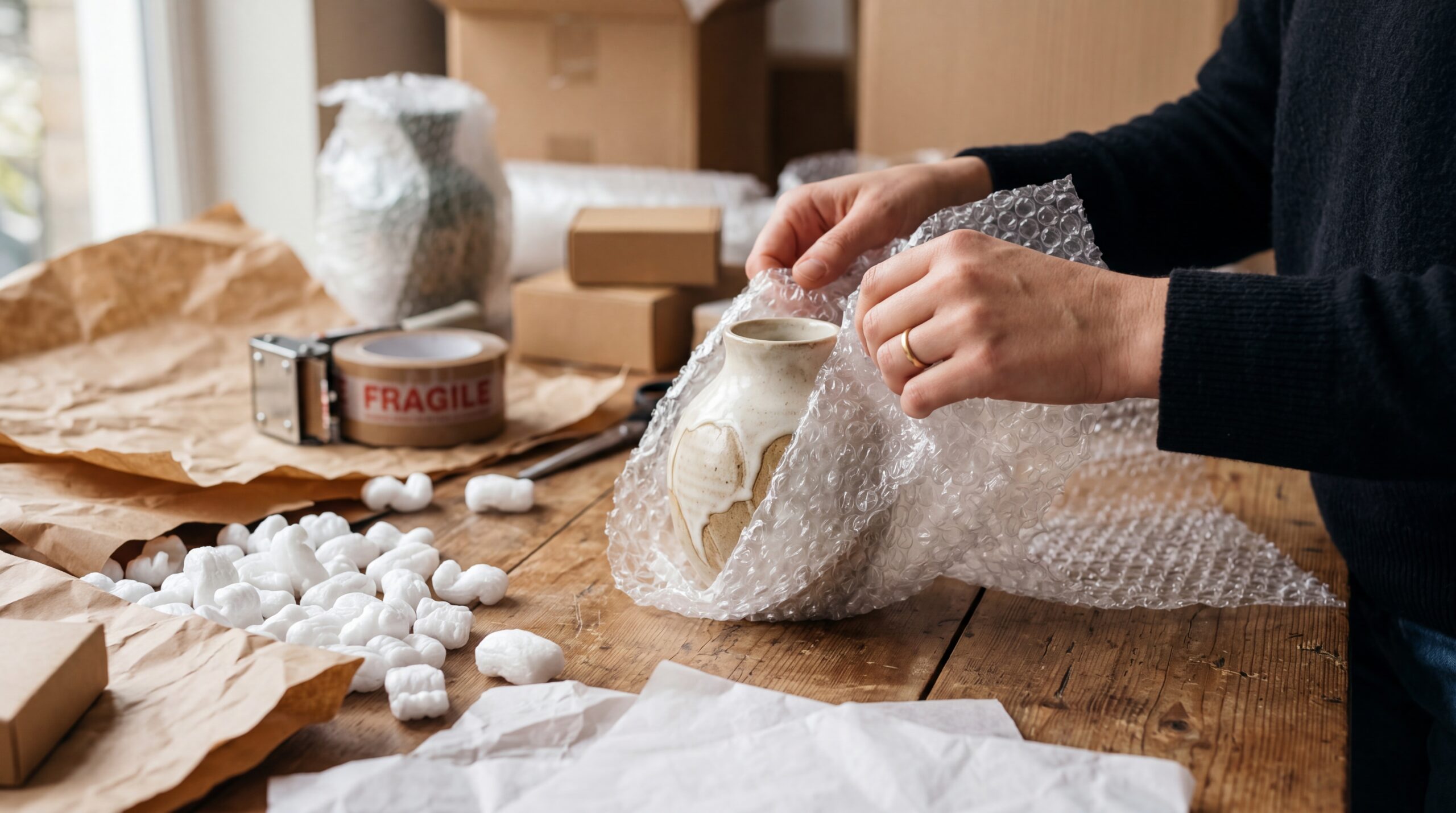
- Wrap each item individually in two to three layers of bubble wrap. Secure the wrap with tape so it stays tight.
- Line the bottom of the box with 3 inches of crumpled packing paper or bubble wrap.
- Place heavier items at the bottom and lighter, more delicate items on top. This keeps the center of gravity low and prevents crushing.
- Fill every gap with crumpled paper. When you close the box, nothing should shift if you shake it gently.
- Add a top layer of padding before sealing. There should be cushioning on all six sides of the box interior.
For particularly valuable ceramics or irreplaceable pieces, we recommend double-boxing: pack the item in a smaller box with full padding, then place that box inside a larger box with at least 3 inches of cushioning material on every side. This creates a suspension effect that dramatically reduces impact damage.
How to Pack Electronics for International Shipping
Electronics are fragile in a different way than glassware. They are sensitive to impact, static, and moisture. Here is what we recommend:
- Use original packaging if you have it. Manufacturers design those boxes and foam inserts specifically to protect the product. If you kept the box your laptop, monitor, or game console came in, use it.
- If you do not have original packaging, wrap the device in anti-static bubble wrap (the pink kind). Regular bubble wrap can generate static that damages circuit boards.
- Remove batteries from any device where possible. Loose batteries can short-circuit during transit.
- Wrap cables separately and tuck them beside the device, not on top of screens or delicate components.
- For monitors and TVs, place a layer of cardboard over the screen before wrapping in bubble wrap. This distributes pressure away from the display surface.
- Include silica gel packets if shipping by ocean freight. Containers can experience humidity fluctuations during long sea voyages, and moisture is the enemy of electronics.
How to Pack Picture Frames and Artwork
Picture frames are one of the trickiest items to pack because glass is fragile and frames have corners that dig into other items. Here is the approach that works:
- Apply painter’s tape in an X pattern across the glass surface. If the glass does crack during transit, the tape holds the shards together and prevents them from scratching the artwork.
- Wrap the entire frame in bubble wrap, paying extra attention to corners. Corner protectors (cardboard or foam) are worth the small investment.
- Pack frames vertically, not flat. Standing frames on edge makes them much more resistant to crushing. Think of it like an egg: strong from the ends, fragile from the sides.
- Place cardboard between each frame if packing multiples in the same box.
- For valuable artwork, consider a custom crate or a picture box designed for this purpose.
The Double-Boxing Technique: When and Why
Double-boxing is the gold standard for shipping fragile items internationally, and we recommend it for anything high-value or irreplaceable. The concept is simple: your item goes into a fully padded inner box, and that box goes into a larger outer box with additional cushioning between the two.
This creates what professional packers call a “box within a box” suspension system. Even if the outer box takes a hard impact, the inner box absorbs and dissipates the force before it reaches the item. We routinely use this method for clients shipping heirloom china, expensive electronics, and delicate antiques through our international mini-move service.
To double-box correctly, make sure there is a minimum of 3 inches of cushioning material — crumpled paper, bubble wrap, or foam — on every side between the inner and outer box.
Crumpled Paper vs. Bubble Wrap: Which Is Better?
We get this question constantly, and the honest answer is: use both.
Bubble wrap is superior for wrapping individual items. It conforms to shapes, provides consistent cushioning thickness, and protects against surface scratches. It is our go-to for direct item contact.
Crumpled packing paper is better for void fill — stuffing the gaps between items and the box walls. Paper is cheaper, easier to shape into irregular spaces, and it does not shift and settle as much as packing peanuts during long transit. Packing peanuts are fine for domestic shipping, but for an international shipment spending weeks in a container, crumpled paper holds its position better.
The ideal combination: bubble wrap on the item, crumpled paper filling every remaining space.
What We See Go Wrong Most Often
After decades of handling international shipments, these are the packing mistakes we see cause damage over and over again:
- No padding on the bottom of the box. People pack the sides and top but forget the bottom takes the most impact when boxes are set down.
- Too much weight in one box. A 70-pound box of kitchen items will have the bottom give out. Keep boxes under 50 lbs for ocean freight.
- Fragile items touching each other. Two unwrapped mugs next to each other will chip. Every single time.
- Using old or single-wall boxes. These collapse under stacking pressure in a shipping container.
- Not enough tape. A single strip of tape across the top is not sufficient. Use the H-taping method: one strip along the center seam and one strip along each edge seam, on both top and bottom.
- Items can shift inside the box. If you can hear or feel anything moving when you shake the box, it needs more packing material.
The Shake Test: Your Final Quality Check
Before you seal any box of fragile items, do the shake test. Pick the box up and gently shake it. If you hear movement or feel shifting, open it back up and add more padding. For international shipping, we recommend going even further: hold the box at waist height and drop it onto a carpeted floor. If you would not feel comfortable doing that, the box needs more protection.
This simple test catches the majority of packing problems before they become shipping damage claims.
Let City Post Express Handle It for You
If packing fragile items for international shipping feels overwhelming, you do not have to do it yourself. City Post Express offers professional packing services as part of our international mini-moves and ocean freight shipping. Our team packs fragile items every day using the same techniques described in this guide, and we stand behind our work.
Get a quote from City Post Express and tell us what you are shipping. We will recommend the best packing approach and handle as much or as little of the process as you need.
City Post Express has been shipping personal belongings from the US to Ireland, the UK, and Europe since 2000. We know what survives the journey and what does not — and we pack accordingly.