How to Ship Furniture Overseas: Costs, Options, and What’s Actually Worth Shipping
A practical guide to shipping furniture internationally — covering LCL vs FCL, real cost ranges, packing and protection tips, and an honest breakdown of when it makes financial sense to ship versus buy new at your destination.
After 25+ years of helping people ship their lives across oceans, one question comes up more than almost any other: should I ship my furniture overseas, or just buy new when I get there?
It is a fair question. International furniture shipping is not cheap, and not every piece deserves a spot on a container. But for the right items, shipping can save you thousands compared to replacing everything at your destination — especially if you are moving to countries where furniture prices run 30–50% higher than in the US.
This guide breaks down the real costs, your shipping options, how to protect your furniture in transit, and a straightforward framework for deciding what is actually worth sending overseas.
How Much Does It Cost to Ship Furniture Overseas?
The cost to ship furniture internationally depends on volume, weight, distance, shipping method, and service level. Here are realistic price ranges for common routes from the United States:
- A few furniture pieces (LCL/shared container): $800 – $2,500
- 1-bedroom apartment load: $2,000 – $5,000
- Full 20-foot container (FCL): $4,000 – $10,000
- Full 40-foot container (FCL): $6,000 – $18,000
These ranges assume ocean freight with professional packing. Air freight costs roughly three to five times more and is rarely practical for furniture.
Several factors push the final bill higher: shipment volume and weight, route distance, service level (door-to-door vs port-to-port), seasonality (summer rates are highest), destination fees like customs inspections and terminal handling, and insurance upgrades. Full-value protection typically adds 1–3% of your declared value.
LCL vs FCL: Which Shipping Method Is Right for Your Furniture?
The two main ocean freight options are LCL (Less than Container Load) and FCL (Full Container Load). Choosing correctly can save you significant money.
LCL (Shared Container)
Your furniture shares container space with other shipments. You pay only for the volume your items occupy. This works best for smaller shipments — a few key furniture pieces, a bedroom set, or a dining table with chairs. Transit times are slightly longer since the container must fill before sailing, and there are more handling touchpoints.
At City Post Express, our international mini moves service is built for exactly this scenario. If you are shipping a handful of furniture pieces alongside boxes and personal belongings, LCL through a mini move is typically the most cost-effective option.
FCL (Full Container)
You rent an entire 20-foot (~1,000 cu ft) or 40-foot (~2,000 cu ft) container. Your items are the only ones inside, meaning less handling and lower damage risk. The trade-off is higher total cost — you pay for the full container whether you fill it or not.
A common mistake is renting a 40-foot container when a 20-foot would suffice. Unless you are moving the contents of a 3+ bedroom home, a 20-foot container handles most furniture moves comfortably. Learn more about our ocean freight services.
Ship It or Leave It? What’s Actually Worth Sending
Here is the honest truth from decades of doing this work: not all furniture is worth shipping overseas. The decision comes down to replacement cost, sentimental value, and quality.
Usually Worth Shipping
- Solid wood furniture that would cost $2,000+ to replace — dining tables, hardwood dressers, quality bookcases
- Heirloom and antique pieces that cannot be replaced at any price
- Custom or specialty items like ergonomic office setups or built-to-measure shelving
- Items that cost more abroad — furniture prices in Ireland, the UK, and much of Europe run significantly higher than US prices
Probably Leave Behind
- Flat-pack and particle board furniture — rarely survives international shipping well, and replacement cost is low
- Oversized sofas and sectionals — a large L-shaped sectional can consume 80+ cubic feet, enough space for dozens of boxes
- Standard mattresses — bulky, and sizes differ between countries (a US queen is not the same as a European queen)
- Anything you have been meaning to replace — an international move is the perfect excuse to upgrade
The quick math: if shipping a piece costs $300–$500 (its share of total container cost) but replacing it locally would run $1,500+, ship it. If replacement cost is $200 and shipping is $400, sell it. For more cost-saving strategies, see our guide on the cheapest way to ship overseas.
How to Protect Your Furniture in Transit
Furniture damage during overseas shipping is almost always preventable. Here is what actually matters:
Wrapping and Crating
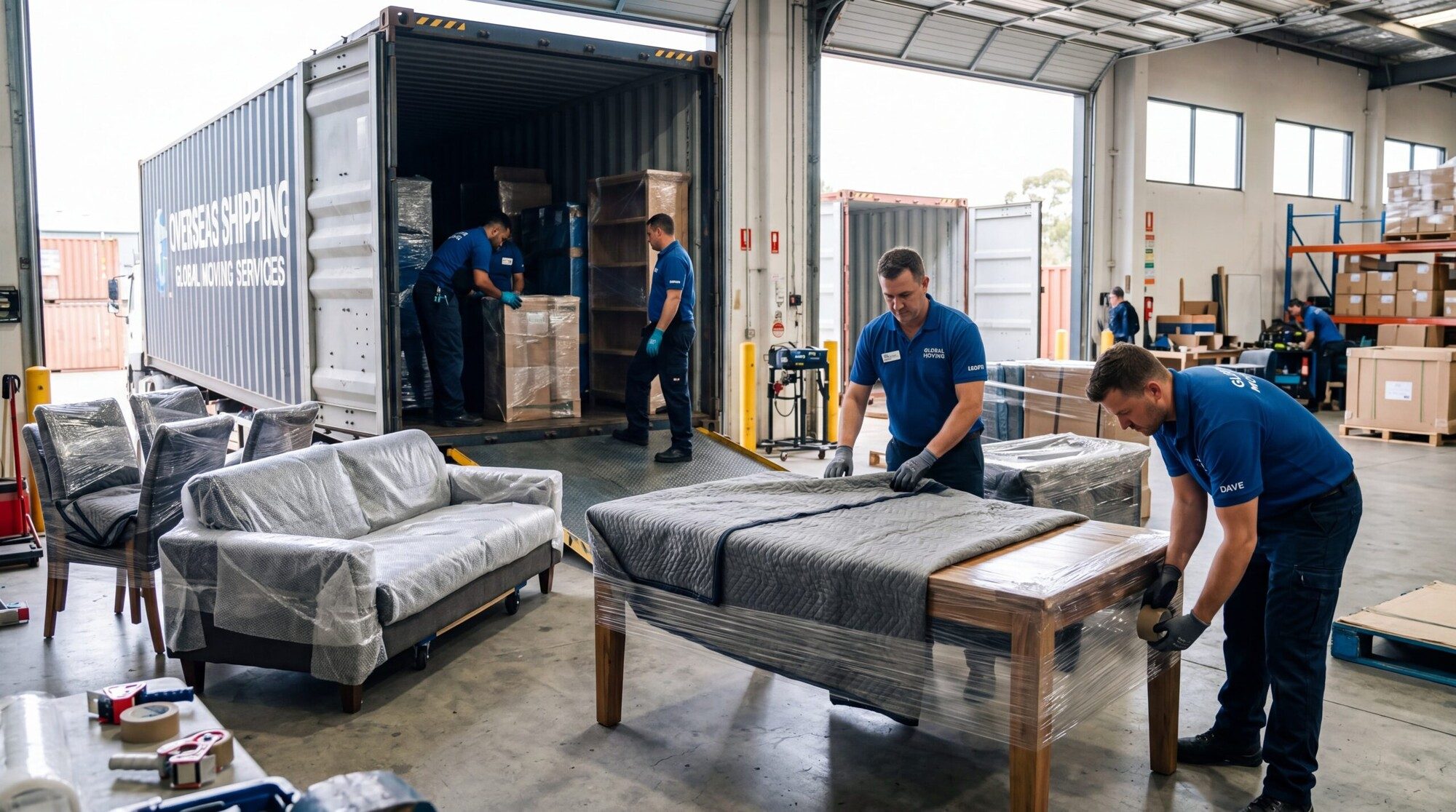
- Blanket wrapping every piece, secured with stretch wrap. This is the baseline.
- Bubble wrap on corners and legs — corners are where most damage occurs.
- Custom crating for high-value items like glass-top tables, marble surfaces, or antiques.
- ISPM-15 compliance — all wood packaging must be heat-treated and stamped per international phytosanitary standards. Non-compliant wood can get your shipment held at customs.
Disassembly Tips
- Remove legs from tables and sofas — wrap separately and label. This dramatically reduces footprint.
- Take apart bed frames completely. Keep hardware in labeled zip-lock bags taped to the frame.
- Remove drawers from dressers and wrap individually. The frame ships lighter and drawers stack efficiently.
- Take photos before disassembly — you will thank yourself at reassembly time.
Moisture Protection
Ocean containers experience temperature swings and humidity changes. Use silica gel packets inside wrapped furniture, apply wax or polish to exposed wood surfaces before wrapping, and avoid plastic wrap directly on wood (it traps moisture — use breathable materials as the first layer).
Common Mistakes That Cost People Money
- Underestimating volume: That sofa you think is “not that big” might take up a quarter of a 20-foot container. Measure everything.
- Skipping insurance: Basic carrier liability is minimal. Full-value protection is worth the premium.
- Ignoring size differences: European doorways and rooms are often smaller than American ones. Measure your new space before shipping large pieces.
- Not researching destination restrictions: Australia and New Zealand are particularly strict on wood and upholstery materials.
- Shipping everything out of obligation: If you would not buy the piece again today, do not pay to ship it across an ocean.
How City Post Express Handles Furniture Shipping
We specialize in shipping from the US to Ireland, the UK, and Europe. Most of our furniture customers fall into two categories:
- Mini moves with a few furniture pieces: 5–25 boxes plus select furniture items. Our international mini moves service uses LCL shipping with full door-to-door service including professional wrapping, ocean freight, customs clearance, and delivery.
- Full container moves: Entire household contents via our ocean freight service with dedicated 20-foot or 40-foot containers.
We have been doing this since 1994 and hold FMC License #034938. We will give you a straight answer about whether a piece is worth shipping — sometimes the best advice is “sell it and buy new.”
Check our shipping packages for pre-priced options, or request a free quote for a custom plan.
Frequently Asked Questions
How long does it take to ship furniture overseas?
Ocean freight from the US to Europe typically takes 2–6 weeks. Shipping to Australia or Asia can take 4–10 weeks. LCL shipments may add 1–3 weeks for consolidation. Air freight delivers in 1–2 weeks but costs significantly more.
Can I ship a single piece of furniture internationally?
Yes. LCL shipping allows you to ship as little as one item. For a single large piece, expect to pay $500–$1,500 depending on route and dimensions.
Is it cheaper to ship furniture or buy new abroad?
High-quality pieces costing $1,500+ to replace are almost always cheaper to ship ($300–$600 per piece as part of a larger shipment). Budget furniture under $500 is typically cheaper to replace. European and Australian furniture prices tend to be higher than US prices, which tips the math toward shipping for quality items.
Do I need to pay customs duties on used furniture?
Most countries allow duty-free import of used personal household goods if you are relocating and have owned the items for 6–12+ months. You will need proof of residency and a detailed inventory. Rules vary by country.
Related Reading
Ready to Ship?
Get a free, no-obligation quote for your move. Door-to-door service with customs clearance included.
Get a Free Quote