Customs Clearance for International Shipping: Complete Guide
Complete guide to customs clearance for international shipping from the US to Europe. Covers the customs clearance process step by step, Transfer of Residence duty-free rules, country-by-country requirements for Ireland, UK, Germany, France, Spain, and Italy, required documents, timelines, duties and taxes, and prohibited items.
What Is Customs Clearance in International Shipping?
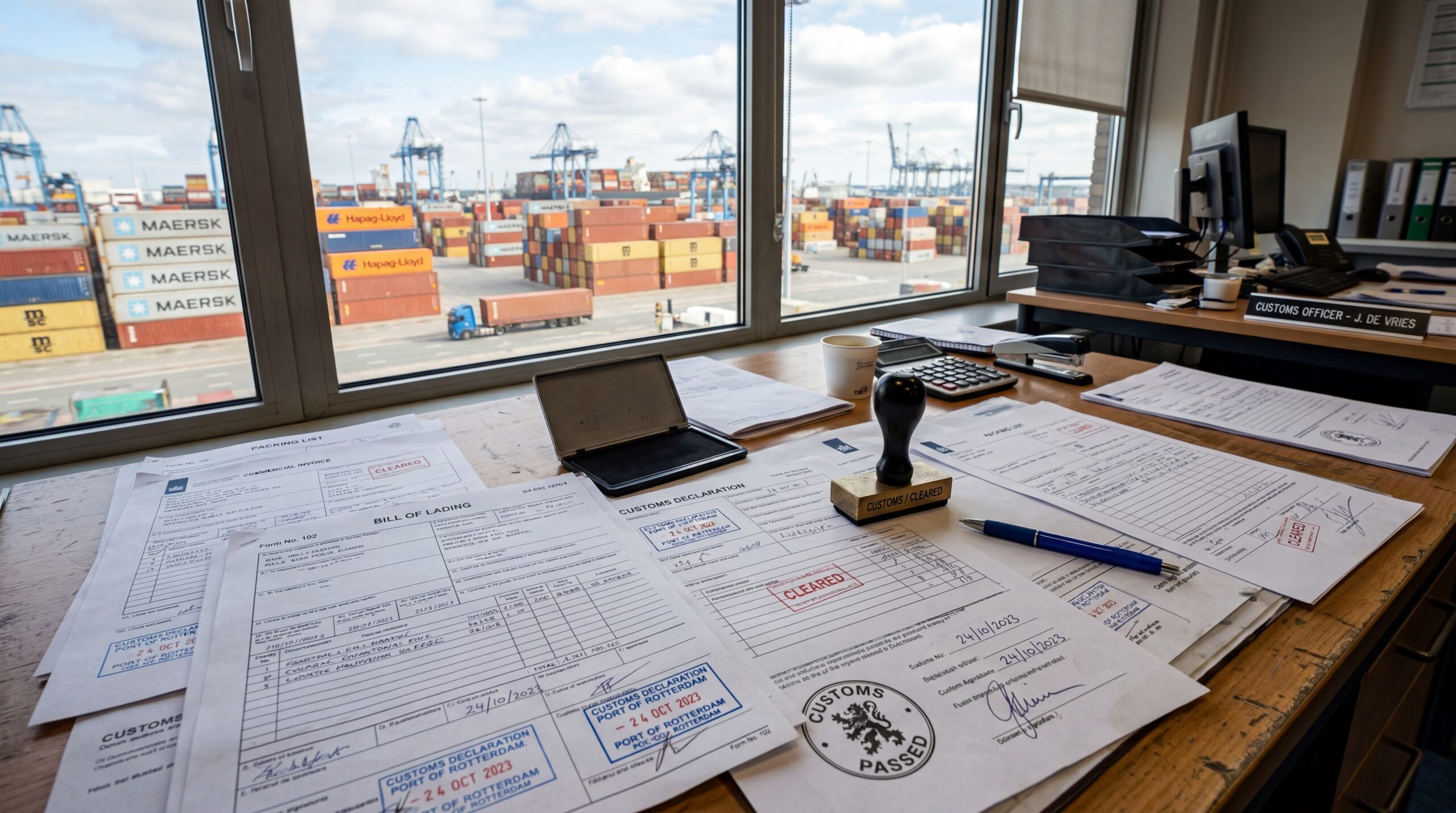
Customs clearance is the formal process of getting a shipment legally approved to enter a destination country. Every item that crosses an international border — whether it is a full container of household goods or a few boxes of personal belongings — must pass through customs authorities at the port of arrival.
For personal shipments from the US to Europe, the customs clearance process is fundamentally different from commercial freight. You are not importing goods for resale. You are moving your own possessions to a new home. Most European countries have specific provisions that allow personal effects to enter duty-free, provided you meet certain conditions.
The customs clearance process for personal shipments typically involves:
- Declaring the contents of your shipment with a detailed packing list and inventory
- Providing supporting documents such as passport copies, proof of residence, visa documentation, and a bill of lading
- Applying for duty-free relief under Transfer of Residence or change of residence provisions
- Paying any applicable duties or taxes on items that do not qualify for exemptions
- Physical or documentary inspection by customs officials at the port of entry
- Release of your shipment for final delivery to your new address
At City Post Express, we handle customs clearance on every shipment we manage. It is included in our service — not an add-on or hidden fee. We have been clearing personal shipments through European and UK customs for over 25 years, and we know exactly what each country requires. Visit our customs guide page for a quick-reference overview of the process.
For a focused explanation of what customs clearance means and why it exists, read our dedicated article: What Is Customs Clearance?
How the Customs Clearance Process Works Step by Step
If you have never shipped internationally before, the customs clearance process can feel like a black box. Here is exactly what happens, step by step, when you ship personal belongings from the US to Europe or the UK with City Post Express.
Step 1: Pre-Shipment Documentation
Before your belongings leave the US, we prepare the export documentation. This includes a detailed packing list (an itemised inventory of everything in your shipment), a bill of lading or airway bill, and your customs declaration. You will provide passport copies and proof of your new address abroad.
Incomplete paperwork is the number one cause of customs delays. We prepare all of this for you as part of our standard service.
Step 2: Export Clearance (US Side)
Your shipment clears US export customs. For personal effects, this is straightforward — the US does not charge export duties on household goods. The key requirement is an accurate Electronic Export Information (EEI) filing for shipments valued over $2,500, which we handle on your behalf.
Step 3: Transit via Ocean or Air Freight
Your shipment travels to the destination country via ocean freight or air freight. Ocean freight typically takes 3 to 6 weeks from the US to Europe; air freight takes 5 to 10 business days. During transit, we pre-file your customs documentation with the destination country’s customs authority so clearance can begin as soon as your shipment arrives at port.
Step 4: Arrival and Import Customs Clearance
When your shipment arrives at the destination port, customs authorities review your documentation. They verify that:
- The contents match the declared packing list
- You qualify for any duty-free exemptions (such as Transfer of Residence relief)
- No prohibited or restricted items are included
- All required supporting documents are present and valid
- The declared values are consistent and reasonable
In most cases, personal shipments clear on documentation alone — no physical inspection is required. However, customs authorities reserve the right to inspect any shipment, and approximately 5 to 10 percent of personal shipments are selected for physical examination.
Step 5: Duty Assessment and Payment
If your shipment qualifies for Transfer of Residence relief (most of our shipments do), no duties or taxes are owed. If any items are dutiable — for example, items purchased less than six months before your move, or brand-new items still in original packaging — the customs authority will issue an assessment. Payment must be made before your goods are released.
Step 6: Release and Final Delivery
Once clearance is granted, your shipment is released from the port or airport. We arrange final-mile delivery to your new address, typically within 1 to 3 business days of customs release. For more on what to expect when shipping personal items internationally, see our guide to shipping personal items internationally.
Transfer of Residence: The Duty-Free Framework for Personal Shipments
The single most important thing to understand about customs clearance for international shipping is the Transfer of Residence (ToR) provision. This is the legal framework that allows you to import your personal belongings duty-free when you relocate to a new country. Getting this right is the difference between paying nothing and paying thousands in duties and VAT.
EU Transfer of Residence (Council Regulation 1186/2009)
The European Union has a harmonised regulation — Council Regulation (EC) No 1186/2009 — that grants relief from import duties on personal property when you transfer your normal place of residence to an EU member state. Each EU country implements this through its own customs authority, but the core requirements are consistent:
- You must have lived outside the EU for at least 12 consecutive months before your move
- The goods must have been owned and used by you for at least 6 months before the transfer
- The goods must be for your personal use — not for commercial purposes, resale, or gifting in quantity
- You must apply within 12 months of establishing residence in the EU country
- You cannot sell, lend, or dispose of the goods for 12 months after import without notifying customs and potentially paying back duties
When approved, Transfer of Residence relief exempts you from both customs duties and VAT on your personal effects. Given that VAT rates in Europe range from 19% in Germany to 23% in Ireland, this exemption can save you thousands of euros on a typical household shipment.
UK Transfer of Residence (ToR1) — Post-Brexit Rules
Since Brexit, the United Kingdom operates its own Transfer of Residence scheme, entirely separate from the EU framework. It is administered by HMRC (His Majesty’s Revenue and Customs). The UK scheme uses the ToR1 form and has these requirements:
- You must have lived outside the UK for at least 12 consecutive months
- Goods must have been owned and used for at least 6 months
- Goods must be for personal use only
- You must apply within 12 months of arriving in the UK
- The ToR1 form must be submitted to HMRC’s National Clearance Hub before your shipment arrives — late applications cause significant delays
We submit ToR1 applications as soon as you book your shipment with us to avoid delays.
For a detailed walkthrough of how Transfer of Residence works specifically for Ireland, see our Transfer of Residence Ireland Guide.
Country-by-Country Customs Clearance Requirements
While the Transfer of Residence framework is broadly similar across EU countries, each nation has its own customs authority, application process, forms, and specific requirements. Here is what you need to know for every country we ship to regularly from the United States.
Ireland
| Customs Authority | Revenue Commissioners (revenue.ie) |
| ToR Application | Form C&E 1076, submitted to Revenue |
| Residency Requirement | 12+ months living outside the EU |
| VAT Rate | 23% |
| Key Requirement | PPS number (Personal Public Service number) needed for customs processing |
| Processing Time | Typically 3 to 5 business days after arrival at Dublin Port |
Ireland is our most popular destination. We clear shipments through Dublin Port multiple times per week. Ireland’s C&E 1076 form requires a full inventory, proof of previous US residence, and evidence of your new Irish address. For full details, see Moving to Ireland from the US. Retirees should read our Retiring to Ireland guide for pension and residency considerations.
United Kingdom
| Customs Authority | HMRC (His Majesty’s Revenue and Customs) |
| ToR Application | ToR1 form, submitted to National Clearance Hub |
| Residency Requirement | 12+ months living outside the UK |
| VAT Rate | 20% |
| Key Requirement | ToR1 must be approved before shipment arrives; post-Brexit, UK is fully separate from EU customs union |
| Processing Time | Typically 2 to 5 business days; can be longer during peak periods |
Since Brexit, the UK customs clearance process has become more involved. The ToR1 form must be pre-approved by HMRC before your goods arrive. Shipments without approval face delays and may be assessed for full duty and 20% VAT. Full details in our Moving to the UK from the US guide.
Germany
| Customs Authority | Zoll (German Customs — zoll.de) |
| ToR Application | Umzugsgut declaration (moving goods declaration) |
| Residency Requirement | 12+ months living outside the EU |
| VAT Rate | 19% |
| Key Requirement | Anmeldung (residence registration) must be completed; goods must arrive within 12 months of Anmeldung date |
| Processing Time | Typically 3 to 7 business days at Hamburg or Bremerhaven |
Germany requires your Anmeldung (residence registration) as proof of residency. Without it, your shipment cannot clear duty-free. Zoll cross-references your packing list against the Anmeldung date to verify the six-month ownership requirement. Complete your Anmeldung within the first two weeks of arrival. See our Moving to Germany from the US guide.
France
| Customs Authority | Douanes (French Customs — douane.gouv.fr) |
| ToR Application | Franchise douaniere (customs franchise) application |
| Residency Requirement | 12+ months living outside the EU |
| VAT Rate | 20% |
| Key Requirement | Proof of new French address required; inventory must be provided in French |
| Processing Time | Typically 3 to 5 business days at Le Havre |
France’s franchise douaniere application requires a detailed inventory in French, which we prepare on your behalf. Read more in our Moving to France from the US guide.
Spain
| Customs Authority | Agencia Tributaria (Spanish Tax Agency — agenciatributaria.es) |
| ToR Application | Transfer of Residence declaration via Agencia Tributaria |
| Residency Requirement | 12+ months living outside the EU |
| VAT Rate | 21% |
| Key Requirement | NIE number (Numero de Identidad de Extranjero) required; empadronamiento (municipal registration) serves as proof of residence |
| Processing Time | Typically 5 to 10 business days; can be longer in Barcelona and Valencia during summer |
Spain’s customs clearance can take longer during summer months when port volumes spike. Your NIE number must be ready before your shipment arrives — without it, clearance cannot begin. The empadronamiento from your local town hall serves as proof of residence. Full details in our Moving to Spain from the US guide.
Italy
| Customs Authority | Agenzia delle Dogane e dei Monopoli (adm.gov.it) |
| ToR Application | Transfer of Residence via Agenzia delle Dogane |
| Residency Requirement | 12+ months living outside the EU |
| VAT Rate | 22% |
| Key Requirement | Codice Fiscale (tax code) and EORI number required; permesso di soggiorno (residence permit) for non-EU nationals |
| Processing Time | Typically 5 to 10 business days; port efficiency varies between Genoa, Naples, and Livorno |
Italy uniquely requires an EORI number for personal shipments. You will also need your Codice Fiscale, obtainable from the Italian consulate before departure or from the local Agenzia delle Entrate after arrival. We assist with EORI registration as part of our service. See our Moving to Italy from the US guide.
For a broader overview of relocating to any European country, our comprehensive Moving to Europe from the US guide covers the full picture including visas, housing, and logistics.
Required Documents for Customs Clearance
Proper documentation is the single biggest factor in whether your shipment clears customs smoothly or gets delayed. Here is exactly what you need — and what we prepare for you.
Documents You Provide
- Passport copy — Clear copy of the photo page. Provide both if you hold dual citizenship.
- Proof of new residence — Lease, utility bill, or property document showing your new address.
- Proof of previous US residence — US lease, utility bills, bank statements, or tax returns showing 12+ months of US residence.
- Visa or residence permit — If applicable, a copy of your visa or proof of right to reside.
- Country-specific ID numbers — PPS number (Ireland), NIE (Spain), Codice Fiscale (Italy), or equivalent.
Documents We Prepare
- Detailed packing list and inventory — Itemised list of every item with descriptions, quantities, and estimated values.
- Bill of lading (ocean) or airway bill (air) — Transport document confirming shipment details and routing.
- Customs declaration forms — Country-specific forms including CN22/CN23, Ireland’s C&E 1076, Germany’s Umzugsgut form, etc.
- Transfer of Residence application — Duty-free exemption application prepared and submitted on your behalf.
- Power of attorney — Authorising us to act as your customs broker at the destination port.
- Electronic Export Information (EEI) — Filed with US CBP for shipments valued over $2,500.
For a step-by-step walkthrough of how to complete customs forms correctly, see our guide on how to fill out customs forms for international shipping.
How Long Does Customs Clearance Take?
The honest answer is: it depends on the destination country, your paperwork, and port conditions. But after clearing thousands of personal shipments, we can give you realistic expectations.
Typical Customs Clearance Timelines by Country
| Country | Typical Clearance Time | Possible Delays |
|---|---|---|
| Ireland | 3 to 5 business days | Up to 10 days during peak periods (July through September) |
| United Kingdom | 2 to 5 business days | Up to 14 days if ToR1 is not pre-approved by HMRC |
| Germany | 3 to 7 business days | Up to 14 days without Anmeldung documentation |
| France | 3 to 5 business days | Up to 10 days for incomplete French-language inventory |
| Spain | 5 to 10 business days | Up to 21 days during summer at Barcelona or Valencia ports |
| Italy | 5 to 10 business days | Up to 14 days without EORI number or Codice Fiscale |
What Causes Customs Clearance Delays?
- Incomplete documentation — The most common cause. A single missing document can add 5 to 10 business days.
- Random physical inspection — Adds 2 to 5 business days. Cannot be avoided but proper documentation reduces risk.
- Port congestion — Summer relocation season and post-holiday periods slow processing.
- Late ToR application — Especially in the UK, late ToR1 submissions cause significant delays.
- Restricted items found — Clearance stops until the issue is resolved.
- Inaccurate packing list — Mismatches between declared and actual contents trigger investigation.
We pre-file everything so clearance can begin the moment your shipment arrives.
For a deeper dive into customs timelines, including air freight vs ocean freight comparisons, read our full article: How Long Does Customs Clearance Take?
Customs Duties and Taxes: What You Might Owe
Most personal shipments from the US to Europe clear duty-free under Transfer of Residence provisions. But not all items qualify, and it is important to understand exactly when duties and taxes might apply so there are no surprises when your shipment arrives.
When Import Duties Apply to Personal Shipments
- Items owned for less than 6 months — May not qualify for ToR relief
- Brand-new, unused items — Still in original packaging or with tags may be treated as commercial imports
- Items for resale or commercial use — Personal effects relief covers personal use only
- Alcohol and tobacco above personal allowances — Limits vary by country (e.g., 1 litre of spirits in Ireland)
- Motor vehicles — Separate procedures with duties, registration taxes, and emissions levies
- Gifts above threshold values — EU duty-free threshold for gifts is 45 euros
Typical Duty Rates for Personal Items
The EU uses the Common Customs Tariff, so duty rates are consistent across member states:
- Clothing and textiles: 8 to 12% duty
- Electronics: 0 to 6% duty (many electronics are duty-free under the WTO Information Technology Agreement)
- Furniture: 0 to 6% duty
- Kitchenware and household items: 3 to 8% duty
- Sports equipment: 2 to 5% duty
- Books and printed materials: 0% (exempt in most countries)
VAT Rates by Country
VAT is also charged on goods that do not qualify for ToR relief:
| Country | Standard VAT Rate | Potential Cost on $5,000 of Dutiable Goods |
|---|---|---|
| Ireland | 23% | $1,150 |
| Italy | 22% | $1,100 |
| Spain | 21% | $1,050 |
| France | 20% | $1,000 |
| United Kingdom | 20% | $1,000 |
| Germany | 19% | $950 |
On a typical household shipment, ToR relief can save you $1,000 to $5,000 or more. We provide a duty estimate as part of our quoting process — no surprises at the destination port.
For a full cost breakdown, see our Cost of Moving Overseas Guide. For the most budget-friendly approach, our Cheapest Way to Ship Overseas guide compares all options.
Prohibited and Restricted Items in International Shipping
Every European country maintains lists of items that cannot be imported (prohibited) or that require special permits (restricted). Customs authorities will seize prohibited items and may impose fines. Restricted items can sometimes be imported with the right documentation.
Commonly Prohibited Items (All European Destinations)
- Narcotics and controlled substances (including marijuana, even if legal in your US state)
- Firearms, ammunition, and weapons without specific import permits
- Counterfeit goods
- Certain food products (meat, dairy, fresh produce — strictly enforced across the EU)
- Endangered species products (ivory, animal skins, CITES-covered items)
- Hazardous materials (flammables, compressed gases, corrosives, large lithium batteries)
Commonly Restricted Items (May Require Permits)
- Prescription medications — Allowed for personal use with a doctor’s prescription and in limited quantities (90-day supply)
- Plants and seeds — May require USDA phytosanitary certificates
- Antiques and artwork — May require US export permits and provenance documentation
- Electrical appliances — Must comply with 220-240V European voltage standards
- Alcohol above personal allowances — Generally 1 to 4 litres of spirits per adult
We review every packing list for prohibited and restricted items before shipping. For the complete reference list, see our guide: Prohibited and Restricted Items in International Shipping.
How City Post Express Handles Customs Clearance
Every City Post Express shipment includes full customs brokerage as standard, whether you are shipping 5 boxes or a full container.
What Is Included in Every Shipment
- Full documentation preparation — All customs declarations, packing lists, and ToR applications
- Pre-filing with destination customs — Documentation submitted before arrival so clearance begins immediately
- Duty and tax assessment — Potential duties calculated before you ship
- Customs brokerage at destination — Our brokers handle all communication with customs authorities
- Issue resolution — We handle inspections, queries, and additional documentation requests
Why a Freight Forwarder Beats Shipping Boxes Individually
Many people consider shipping boxes through USPS, UPS, or FedEx to save money. Here is why that approach almost always costs more:
- Each box clears customs individually — Instead of one consolidated customs declaration, you have 10, 15, or 20 separate clearances. Each one is a chance for delays, inspections, or duty assessments.
- No Transfer of Residence protection — Individual postal shipments typically do not qualify for ToR relief. Each box may be assessed for full customs duties and VAT.
- No customs broker — When a box gets held, you are on your own navigating a foreign customs office.
- Higher total cost — Per-box rates plus potential duties plus your time dealing with issues almost always exceeds a consolidated shipment.
- Risk of lost boxes — With 20 individual shipments, the chance of losing at least one is substantially higher.
With City Post Express, your entire shipment clears as one consignment under one Transfer of Residence application. One declaration. One clearance. One point of contact.
Whether you are shipping via our ocean freight, air freight, or international mini moves service, customs brokerage is always included. To compare the differences between shipping methods, see our article on ocean freight vs air freight. For students moving abroad, our student shipping service includes the same full customs clearance support.
Frequently Asked Questions About Customs Clearance
Do I need a customs broker for personal shipments?
You are not legally required to hire one, but we strongly recommend it. Customs regulations are complex and vary by country. A single error on a form can delay your shipment by weeks. When you ship with City Post Express, customs brokerage is included — no extra charge.
What happens if my shipment is inspected?
Customs will open and examine the contents to verify they match your declaration. This typically adds 2 to 5 business days. As long as your documentation is accurate and you have not included prohibited items, inspection is a minor inconvenience. We are present for all inspections.
Will I owe duties on used personal items?
In most cases, no. If you qualify for Transfer of Residence relief — meaning you lived in the US for at least 12 months and your belongings have been owned and used for at least 6 months — your personal effects clear duty-free and VAT-free. Brand-new or recently purchased items (under 6 months old) may be assessed.
Start Your Move with Confidence
Customs clearance does not have to be stressful. City Post Express has cleared thousands of personal shipments through customs in Ireland, the United Kingdom, Germany, France, Spain, Italy, and across Europe.
Ready to get started? Get a free quote or contact us to discuss your move.
Related Guides and Resources
- Customs Guide — Quick-reference customs overview
- Moving to Ireland from the US
- Moving to the UK from the US
- Moving to Germany from the US
- Moving to France from the US
- Moving to Spain from the US
- Moving to Italy from the US
- Moving to Europe from the US
- Retiring to Ireland from the US
- How Much Does It Cost to Move Overseas?
- Cheapest Way to Ship Overseas
Ready to Ship?
Get a free, no-obligation quote for your move. Door-to-door service with customs clearance included.
Get a Free Quote